
by Selva
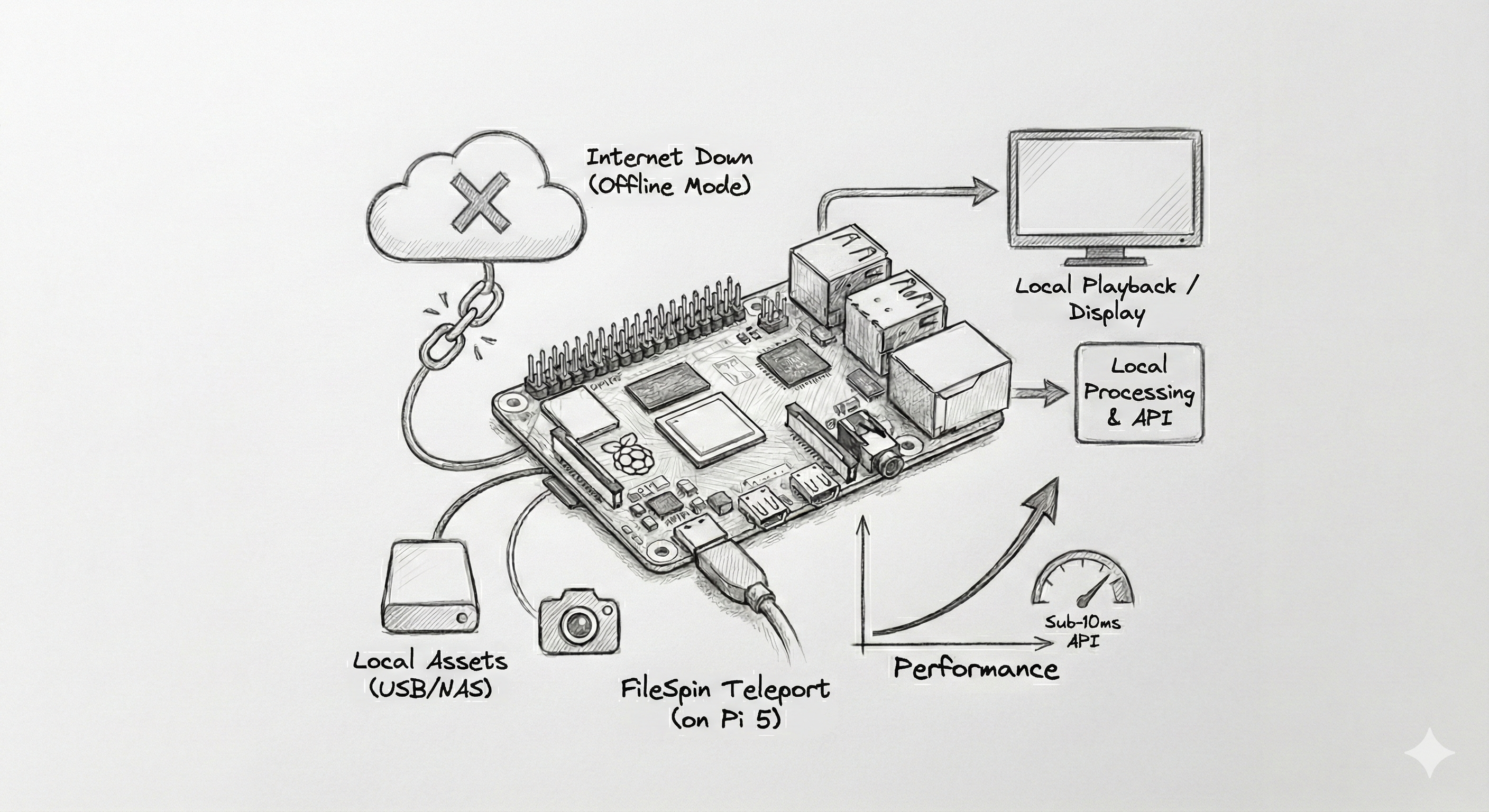
Last week I installed our media infrastructure – FileSpin Teleport – on a Raspberry Pi 5.
Teleport is our hybrid media runtime—it supports media operations locally exposing the same APIs as FileSpin Cloud at customer sites, with automatic cloud sync when connectivity is available. We designed it for enterprise operations at distributed venues and events where internet connectivity can't be guaranteed.
I knew Teleport can run on a Pi as our team has already tested it. But how well could it run on an $80 single-board computer and what kind of load can it serve?
Running FileSpin Teleport on Raspberry Pi 5
There's value in stripping systems down to essentials. Coming from an old-school mindset of squeezing the most out of every compute cycle, benchmarking Teleport on a Pi is compelling. It's been all too easy to hide inefficiencies in modern software deployments using cloud and hyperscaling. It's easy to forget that a little local computer can go a long way.
So, how far can the Pi 5 go? Further than most enterprise teams would expect.
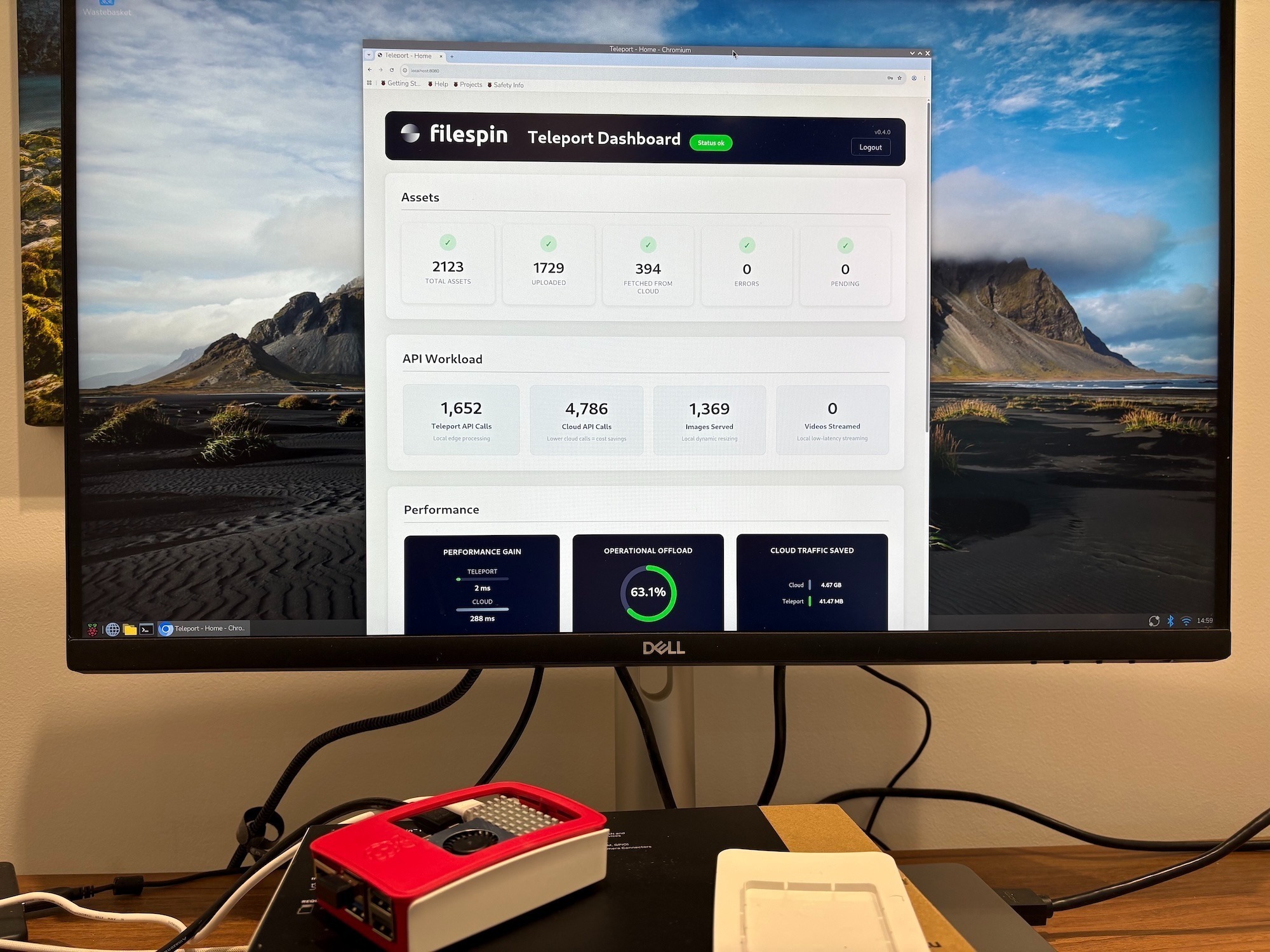
Teleport Dashboard running on Raspberry Pi 5.
I set up the Pi experiment not as a demo or toy example. Teleport ran for a week. Every five minutes a script copied hundreds of files into its hot folder—the folder that Teleport monitors to sync assets to the cloud. Over the week, I randomly disconnected the Pi from its power supply. Killed the network connection. Let my two-year-old dog get a taste of it too. (I rescued the Pi before he could damage the hardware.)
It kept running.
Performance Benchmarks: API Response Times and Throughput
Teleport has a built-in hardware benchmarking suite to help customers right-size their hardware for operations. This is handy for our customers to assess operational hardware needs without overcommitting. We built the benchmark as a hardware assessment tool to guide real-world operations. The benchmark suite tests APIs, dynamic image resizing, video streaming using range requests, and stress tests disk I/O.
I ran hardware benchmarking on the Pi 5 with Teleport serving up image and video thumbnails, asset API, search API, downloads and video streams.
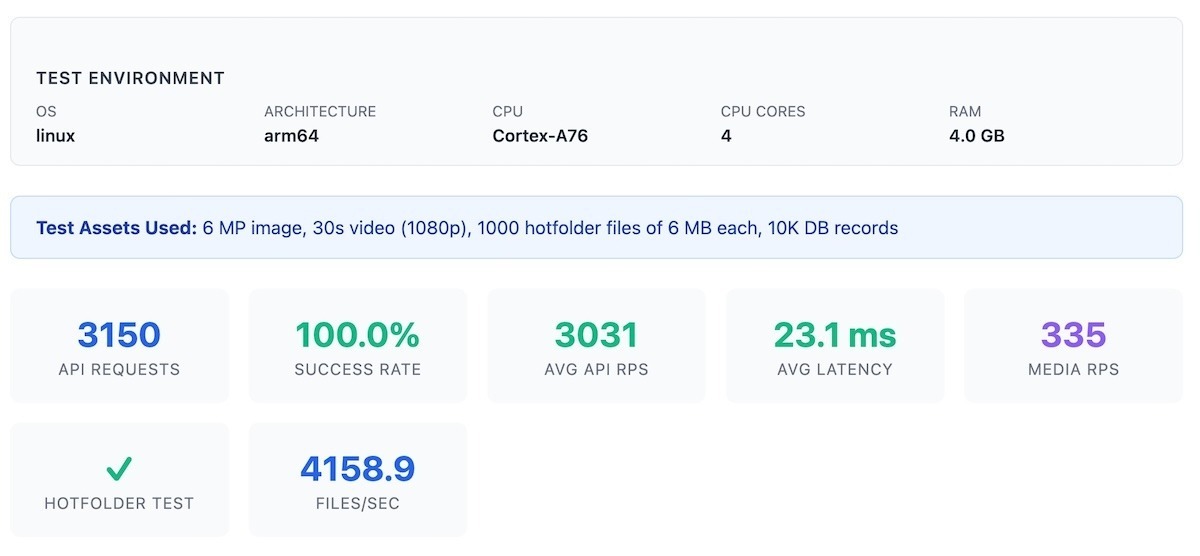
Benchmark results - 23.1ms average latency, 3,031 avg API RPS on Raspberry Pi 5 (Cortex-A76, 4 cores, 4GB RAM)
Results: Sub-10ms API Performance on $80 Hardware
The Pi performed remarkably well. So did Teleport. The asset APIs were all under 10 milliseconds for 10 concurrent API clients sending hundreds of requests per second. For image transformations, Teleport + Pi 5 handled dynamic image resizing incredibly well – image gallery pages with thumbnails loaded instantly. Video streaming range requests were even faster. Perhaps no serious enterprise is going to run its media platform on a Raspberry Pi. However, if I ran operations on the ground for events, media kiosks, or any other media workflow that demands local-first operations, I would have Teleport installed on a bunch of Raspberry Pis and a reliable disk or a tiny NAS with its own power.
Want to see Teleport in action? We're opening early access for operations teams running distributed venues or events. Schedule a demo or contact our team to discuss your deployment.
.jpg?width=300&name=unnamed%20(1).jpg)