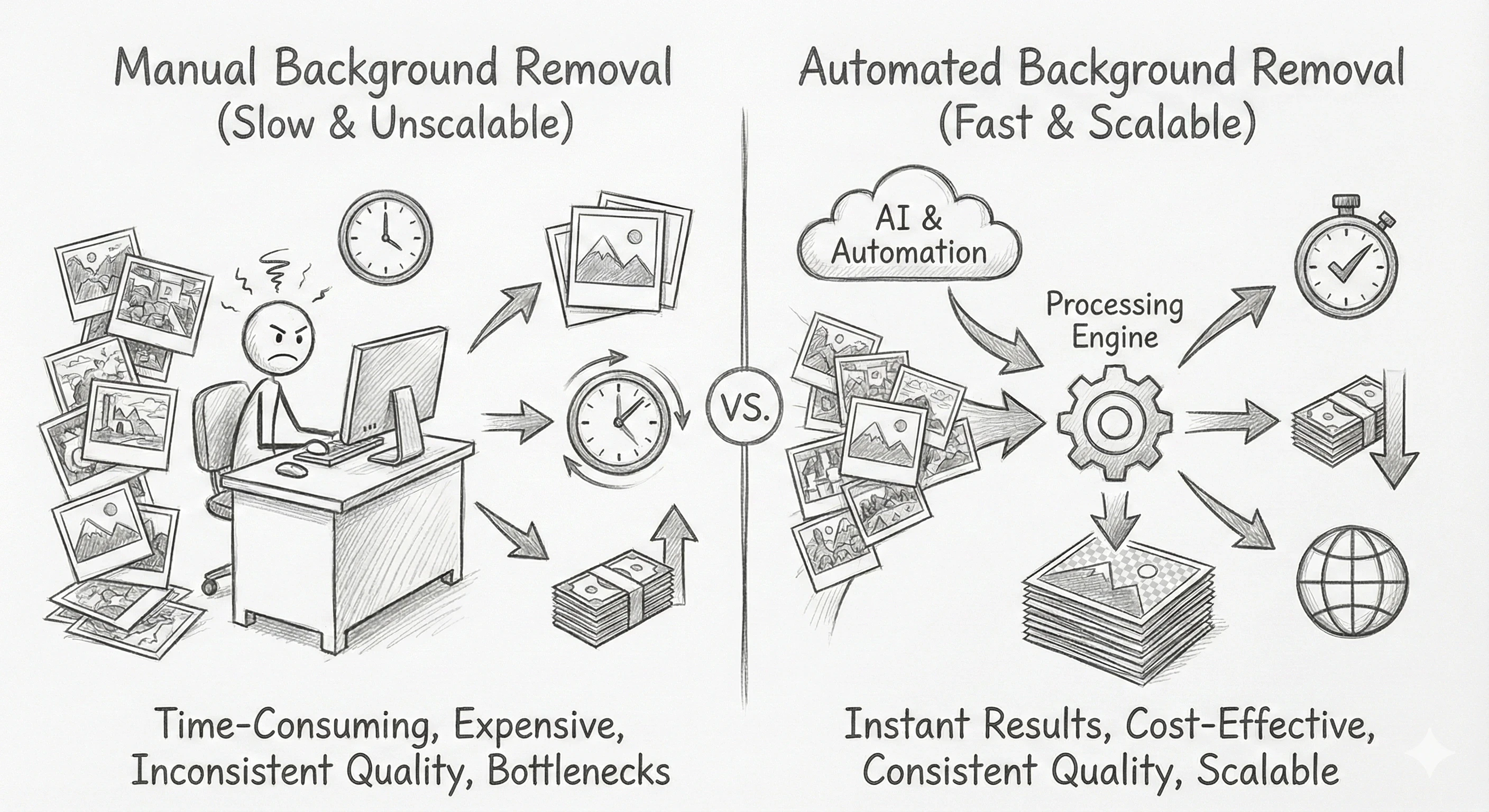
Product photography creates significant operational challenges when each product requires different treatments across multiple sales channels. A typical item needs specific presentations for branded websites, Amazon marketplace, eBay, Instagram Shopping, and Google Shopping—each with distinct background requirements.
Amazon mandates pure white backgrounds while Instagram favors lifestyle photography. Your website might require both formats across product pages and promotional sections. Managing these requirements manually across thousands of SKUs becomes unsustainable as catalogs grow and channel distribution expands.
Background removal enables a single photography session to generate assets for multiple channels. However, traditional approaches—in-house designers, outsourced contractors, or manual editing software—fail to scale and create operational bottlenecks.
Why Clean Backgrounds Matter
Marketplace compliance drives most background removal needs:
Amazon: RGB 255,255,255 pure white mandatory for main images
Google Shopping: Clean backgrounds strongly preferred
Instagram Shopping: Consistent standards prioritizing visibility
Beyond compliance, white backgrounds increase purchase intent by 24% compared to busy backgrounds. Clean backgrounds also enable cross-channel consistency, accelerated content creation, testing flexibility, and seasonal campaign agility.
The Scale Challenge
Manual editing works for small catalogs but fails at scale. Professional editors spend 5-15 minutes per standard product, extending to 30+ minutes for complex items like jewelry or glassware. For 1,000 products with 5 images each (5,000 total), manual processing creates severe bottlenecks. Outsourcing reduces costs but introduces 24-48 hour turnaround delays, quality inconsistencies, and peak season capacity constraints.
Marketplace Requirements
Amazon Standards
Pure white background (RGB 255,255,255)
Product occupies 85% of frame
No watermarks, text, or props
Non-compliance results in listing suppression
eBay and Instagram
eBay’s Best Match algorithm favors clean backgrounds, directly linking background quality to search ranking. Instagram permits flexibility but consistent styling improves brand perception.
Automated Processing Solution
AI-powered background removal uses computer vision to identify product boundaries and execute precise separation in seconds:
Content detection: Identifies primary product
Edge detection: Traces boundaries accommodating complex shapes
Segmentation: Separates product with pixel-level precision
Alpha channel creation: Generates transparent PNGs
Quality validation: Automated verification before distribution
Batch processing enables simultaneous handling of hundreds or thousands of images. Catalogs require 40 hours of manual editing process in under 2 hours.
Quality factors: High-resolution inputs with clear boundaries produce superior results. Simple products like electronics process reliably; complex items with intricate edges or transparent elements need advanced algorithms. Consistent lighting significantly improves reliability.
Real-World Implementation
Consider an apparel retailer with 800 SKUs, each requiring five images for different channels—totaling 4,000 images per seasonal collection.
Previous manual process: Designers spent 8-12 minutes per image removing backgrounds in Photoshop, then creating channel-specific versions. Multiple revision rounds occurred when requirements changed. Processing a complete seasonal catalog consumed several weeks, delaying product launches significantly.
Automated workflow:
Photography process unchanged—same studio setup produces source images
Entire catalog uploads in batch
Automated system generates transparent PNGs with clean edges
Channel-specific versions auto-generate: white for Amazon, transparent for website, optimized for Instagram
Quality validation identifies 5% for manual designer review
Remaining 95% process without human intervention
New product lines reach channels in days rather than weeks. Seasonal campaigns launch on schedule. When marketplace requirements change, catalog-wide reprocessing completes in hours.
Implementation Best Practices
Start with high-volume categories for immediate impact and system validation
Maintain photography standards: Consistent lighting, sufficient contrast, high resolution, complete angle coverage in initial sessions
Build validation protocols: Automated checks combined with 5-10% manual spot-checking
Plan exception handling: Route complex products (intricate jewelry, unusual shapes) to designers while bulk processing continues
Document channel requirements: Maintain specifications for marketplace compliance
Monitor marketplace feedback: Track responses to identify needed adjustments
Common Challenges
Variable input quality: Inconsistent photography produces variable results. Solution: Establish photography standards before implementing automation.
Complex product categories: Jewelry chains, glassware reflections, and intricate lace challenge edge detection. Solution: Route to hybrid workflows combining automation with designer finishing.
Channel requirement changes: Platforms update specifications requiring reprocessing. Solution: Archive source files enabling rapid catalog-wide reprocessing.
Quality validation at scale: Reviewing thousands manually becomes a bottleneck. Solution: Implement tiered validation—automated checks on 100%, manual review of statistical samples.
Background removal at scale automates repetitive tasks, freeing skilled teams for creative decisions and genuine exceptions. For operations managing large catalogs across multiple channels, automation transforms background removal from bottleneck into solved problem enabling business growth.
Learn More:
FileSpin Background Removal:https://developers.filespin.io/reference/image-remove-background
E-Commerce Solutions: https://filespin.io


