From Manual to Autonomous: The Next Generation of Media Workflows
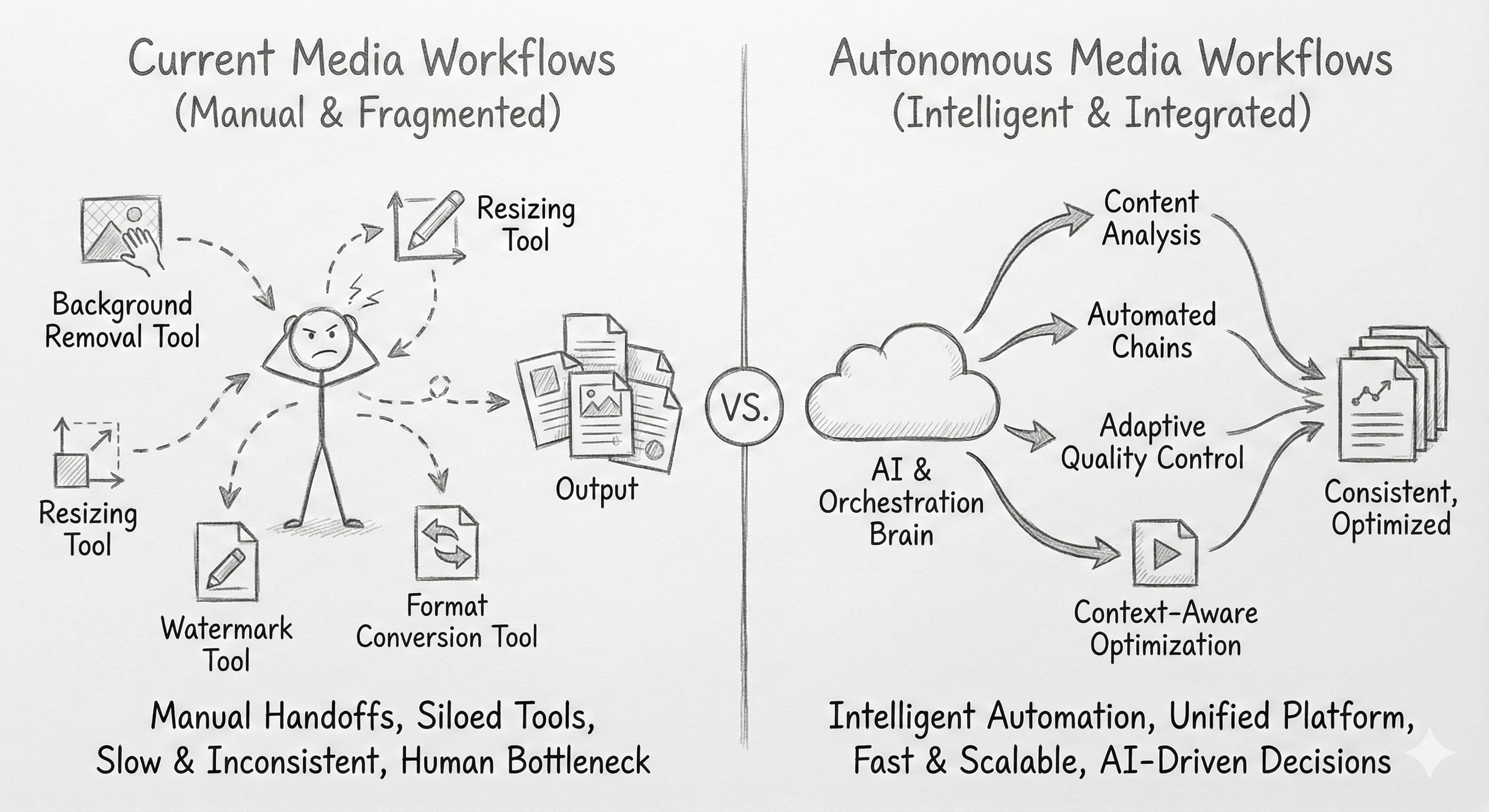
Enterprise media operations handle thousands of assets daily. Product images require background removal, color correction, and format conversion. Marketing campaigns need watermarks applied consistently. Brand guidelines demand specific crops and dimensions across channels.
Today, most of these workflows involve humans clicking through repetitive tasks. Upload an image, open editing software, remove background, export, upload again. Multiply this across thousands of assets and dozens of use cases.
The cost isn't just time. It's inconsistency, bottlenecks, and the inability to scale operations as asset volumes grow. Manual workflows that work for hundreds of images break down at thousands.
The next generation of media infrastructure shifts this model fundamentally: from manual execution to autonomous processing driven by intelligent automation.
The Current State: Where Workflows Break Down
Traditional media workflows follow predictable patterns. Assets enter the system, humans identify what needs to happen, tools execute transformations, outputs are delivered. This works until scale, complexity, or speed requirements exceed manual coordination.
Manual Decision Points
Every workflow requires human judgment: Which images need background removal? What quality level? Which format? Where does output go? For enterprises processing thousands of daily assets across multiple brands and channels, decision-making becomes the bottleneck.
Tool Fragmentation
Media operations span multiple specialized tools. One removes backgrounds. Another resizes. A third manages watermarks. Integration falls to engineers building custom connections between disconnected systems.
Inconsistent Execution
Manual workflows depend on individuals following guidelines consistently. Variations creep in. Brand standards get interpreted differently. At scale, the same asset processed by different team members produces different outputs.
Scaling Limitations
Hiring more people doesn't scale linearly. Coordination overhead grows. Training takes time. Quality control becomes harder. Operations that work for current volumes can't handle 10x growth without fundamental restructuring.
What Intelligent Automation Enables
AI capabilities transform how workflows function by handling pattern recognition and execution autonomously.
Autonomous Content Understanding
Modern computer vision analyzes images at scale: identify products, detect backgrounds, recognize faces, read text, classify scenes. Systems make workflow decisions without human review. Uploaded product images trigger background removal automatically. Portrait photos route to face-aware cropping.
Rule-Based Processing Chains
Predefined rules determine transformations. E-commerce product images follow one chain: background removal, specific dimensions, format requirements. Marketing images follow different rules: watermarks, size variations, channel optimizations. Chains execute automatically based on metadata, content analysis, or destination requirements.
Adaptive Quality Control
Systems validate outputs against standards: verify backgrounds are removed, confirm dimensions match specs, check watermark positioning, detect errors. Validated assets proceed automatically. Only edge cases requiring judgment route to human review.
Context-Aware Optimization
Different contexts demand different optimizations. Mobile needs smaller files. Print requires higher resolution. Social platforms have specific dimensions. Workflows optimize for destination automatically, generating appropriate variations without manual specification.
The Four Stages of Workflow Intelligence
Evolution toward autonomous workflows happens in stages, each building on the previous:
Stage 1: Automated Execution
Basic automation handles repetitive tasks consistently. Apply the same transformation to every asset meeting certain criteria. This eliminates manual clicking but still requires humans to define what happens when.
Stage 2: Conditional Logic
Systems make simple decisions based on rules. If dimensions exceed the threshold, resize. If transparency exists, preserve it. Decision-making begins to shift from humans to systems, though rules must still be manually configured.
Stage 3: Content-Aware Processing
AI analyzes asset content and determines appropriate processing. Recognize this is a product photo requiring background removal. Identify this contains faces needing protection. The system sees what's in the content and acts appropriately without explicit rules for every scenario.
Stage 4: Autonomous Optimization
Systems not only process but optimize. Learn which transformations work best for which content types. Adapt quality settings based on use case. Route assets through optimal processing paths automatically. Workflows improve themselves based on outcomes and patterns.
What This Requires from Infrastructure
Intelligent workflows demand infrastructure designed for automation:
API-First Architecture: Every transformation, validation, and routing decision accessible programmatically for system orchestration.
Unified Asset Understanding: Single source of truth about asset content, usage, and requirements—metadata and processing history available to workflow logic.
Composable Processing: Transformation capabilities that chain programmatically, building complex workflows from simpler operations.
Extensibility: Ability to incorporate new AI capabilities as they become available without infrastructure replacement.
Observability: Visibility into workflow execution, decision-making, and optimization opportunities.
The Transition Path
Moving from manual to autonomous follows a practical evolution:
Start with high-volume repetitive tasks. Automate workflows teams execute hundreds of times daily with minimal variation for immediate efficiency gains.
Add intelligence to decision points. Where humans currently decide asset routing, implement content analysis that makes determinations automatically.
Validate before trusting. Run automated workflows parallel to manual processes initially. Compare outputs, identify edge cases, refine logic.
Expand to complex workflows. Once simple automation works reliably, extend to workflows with more conditional logic.
Measure and optimize. Track where automation saves time and improves consistency. Identify remaining bottlenecks and address systematically.
Why This Matters Now
Asset volumes grow faster than teams. E-commerce catalogs expand. Content marketing scales. User-generated platforms handle millions of uploads.
Manual workflows that functioned adequately five years ago break under current loads. Hiring provides temporary relief but doesn't solve fundamental scaling problems. AI capabilities enabling intelligent automation are no longer experimental. Computer vision, content understanding, and automated optimization work reliably at production scale. Organizations building media infrastructure today should architect for autonomy from the start. Not because every workflow needs AI immediately, but because volume increases, manual coordination breaks, and intelligent automation becomes necessary.
The question isn't whether workflows become more autonomous. It's whether your infrastructure is ready when they do.