Modern applications serve billions of media assets daily. A single e-commerce platform might deliver millions of product images. A social network handles user uploads at a massive scale. Content management systems orchestrate media across multiple channels and formats. Behind every image that loads on a screen sits infrastructure handling storage, processing, transformation, and delivery. The architecture of this infrastructure determines whether media operations scale efficiently or become expensive bottlenecks. Understanding how modern media infrastructure works reveals why some approaches handle growth seamlessly while others require constant intervention.
The Three Core Layers
Media infrastructure operates across three fundamental layers, each solving distinct problems:
Storage Layer
Assets must persist reliably and remain accessible. Modern media infrastructure uses object storage (AWS S3, Google Cloud Storage, Azure Blob Storage) as the foundation.
Object storage provides:
Infinite scale: Storage expands automatically as asset volume grows.
Geographic distribution: Assets replicate across regions for redundancy and proximity.
Versioning: Previous versions remain accessible for rollback or compliance.
Metadata support: Rich metadata enables searchability and organization. The storage layer ensures assets persist reliably and can be retrieved when requested.
Processing Layer
Raw uploads rarely match delivery requirements. The processing layer transforms assets from source to delivery-ready outputs.
Processing can happen:
At upload time: Generate common transformations immediately for instant availability.
On-demand: Transform when first requested, avoiding wasted work on unused transformations.
Scheduled batch: Process large volumes during off-peak hours.
Processing handles format conversion, dimension changes, quality optimization, and watermarking. The key decision: centralized processing (simpler) versus distributed workers (scales horizontally).
Delivery Layer
Assets need to reach users quickly regardless of location. Content Delivery Networks (CDNs) cache assets at edge locations worldwide. When a user requests an image, they retrieve it from a nearby edge server rather than origin storage, reducing latency from hundreds of milliseconds to tens. CDNs handle caching policies, invalidation, smart routing, compression, and security (DDoS protection, rate limiting).
Request Flow Architecture
Understanding how these layers interact reveals how architecture choices impact performance and flexibility.
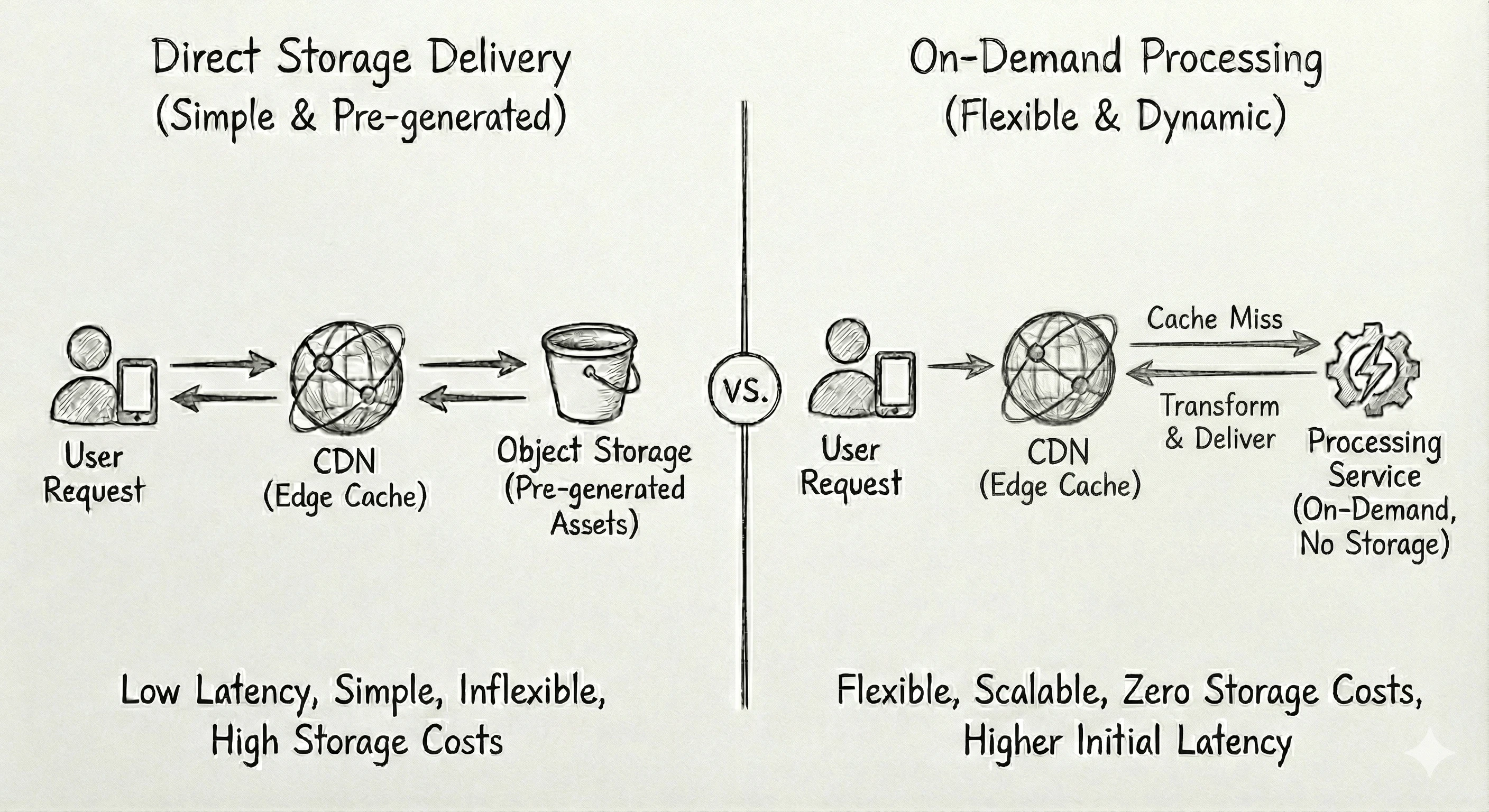
Direct Storage Delivery
The simplest architecture serves assets directly from storage:
User Request → CDN → Object Storage → Response
This works when:
Assets are already in delivery-ready format
No transformation needed at request time
Storage supports direct public access
Advantages: Simple, minimal components, low latency for cached requests.
Limitations: Inflexible, requires pre-generating all variations, storage costs multiply with variations.
On-Demand Processing
More flexible architectures insert processing between storage and delivery:
User Request → CDN (miss) → Processing Service → Transform → CDN (cache) → Response
First requests trigger processing. Subsequent requests hit CDN cache. This architecture enables:
Dynamic transformations via URL parameters
Storage of only source assets, not every variation
Flexibility to add new transformation requirements without re-processing
The trade-off: first requests slower due to processing time. Caching mitigates this for popular assets, but cold requests pay the processing penalty.
Hybrid Approaches
Production systems often combine approaches:
Common transformations: Pre-generated at upload for immediate availability.
Uncommon transformations: Generated on-demand when requested.
Archives: Original high-resolution assets stored separately from delivery versions.
This balances immediate availability for high-traffic use cases against flexibility for edge cases.
API-First Architecture
Modern media infrastructure exposes capabilities through APIs rather than manual interfaces. This enables programmatic orchestration.
FileSpin exemplifies this pattern. Operations happen through API calls:
Asset upload:
POST /upload
Transformation request:
GET /conversions?resize=800,600
Batch processing:
POST /process
API-first architecture enables:
Automation: Systems can orchestrate complex workflows without human intervention.
Integration: Applications integrate media capabilities without custom infrastructure.
Flexibility: New transformations or operations added without UI changes—they’re just new API parameters.
Scalability: APIs handle programmatic load more efficiently than manual interfaces.
The architectural principle: media infrastructure should be composable. Applications call APIs for capabilities they need. Infrastructure handles complexity internally.
Design Considerations
Effective media infrastructure balances multiple concerns:
Performance vs. Cost: Pre-generation delivers speed but multiplies storage. On-demand saves storage but adds latency. Optimize based on access patterns.|
Flexibility vs. Predictability: Static approaches are predictable but inflexible. Dynamic approaches adapt but introduce variability.
Centralization vs. Distribution: Centralized is simpler. Distributed scales better. Start centralized, distribute when load demands.
Stateless vs. Stateful: Stateless scales easier. Media infrastructure favors stateless design at the request layer.
Why Architecture Matters
Infrastructure architecture isn’t just technical detail—it determines operational characteristics:
Scalability: How systems handle 10x growth in assets or traffic.
Cost efficiency: Whether resources are optimized or wasted.
Flexibility: How quickly new requirements can be accommodated.
Reliability: Whether systems degrade gracefully under load or fail catastrophically.
Developer velocity: How easily teams can build features using media capabilities.
Organizations building media-heavy applications benefit from understanding these architectural patterns. Not because everyone needs to build infrastructure from scratch—modern platforms like FileSpin provide production-ready implementations. But understanding the architecture reveals why certain approaches work better for specific use cases. Why on-demand transformations make sense for some applications. Why pre-generation serves others. Why API-first patterns enable flexibility traditional systems can’t match.
The goal isn’t just serving images. It’s serving them at scale, cost-effectively, with flexibility to adapt as requirements evolve.
Learn More:
FileSpin API Documentation: https://developers.filespin.io/reference/welcome
Asset Management & Storage: https://developers.filespin.io/reference/asset-management
CDN Delivery with FileSpin: https://filespin.io
Getting Started Guide: https://developers.filespin.io/docs