Migration guide
Move media from Air to FileSpin
Build a reconciled asset library and a working delivery route. Start with a campaign handoff: find the selected version, organise it by product and market, collect the final review and prepare the web images and product video for delivery.
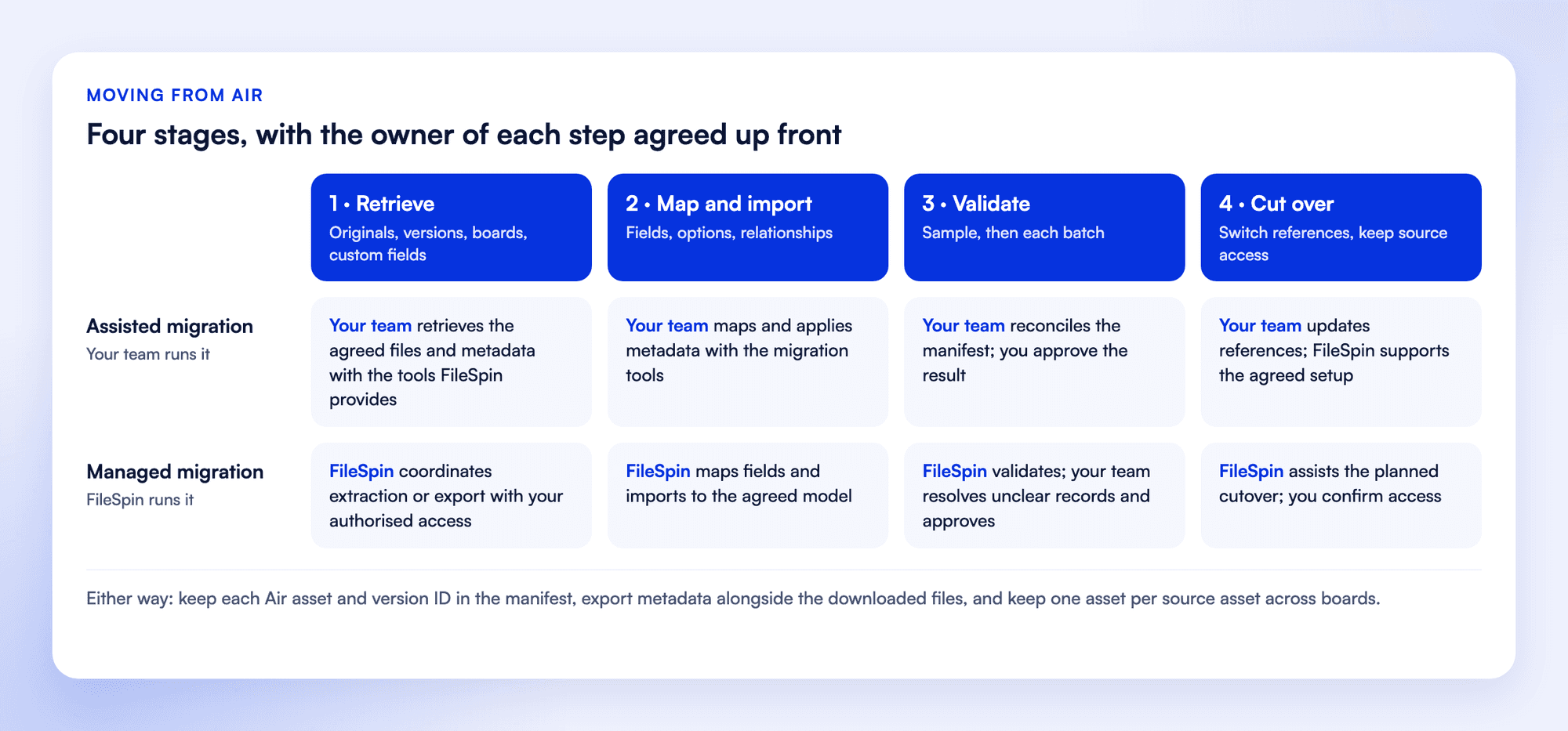
There are two ways to run the move. Both start with an inventory and a representative sample before the full transfer.
1. Retrieve the source files and records
With authorised Air API access, use the workspace ID and API key to list assets with cursor pagination. Include nested boards when your chosen board scope requires them. Save asset IDs and version IDs separately. Retrieve the download URL for each required version through the asset-version download endpoint. Export tags and custom fields alongside the files; downloads do not automatically embed the workspace’s tags. List assets with cursor pagination, up to 500 per page, within 15 requests a second and 10 concurrent requests per API key. Use includeNestedAssets for nested boards.
Retrieval uses an authorised source account, with credentials kept out of exports, screenshots and public URLs. Each completed inventory page and download is saved, so interrupted work resumes where it stopped, and expired download links are refreshed.
2. Create a manifest you can reconcile
One record per source file or retained version: source system, asset ID, file or version ID, original name, source path, file type, bytes, a checksum recorded at download, tags, custom metadata, collection membership, rights information and source update time. The FileSpin asset ID and transfer status are added as work progresses.
Original files are kept separate from thumbnails and delivery renditions. Every exception, such as a missing original, a restricted download or an unsupported format, is listed with its resolution.
3. Map what moves and what gets rebuilt
Part of the library | What happens |
|---|---|
Originals | Authorised source files downloaded and reconciled against the manifest |
Metadata | Preserve board membership without creating extra copies of the same asset. Map custom-field IDs and option IDs to readable values and destination fields, and record the selected cover/current version. |
Collections | Membership rebuilt from source IDs after import |
Versions | The revisions you keep, retrieved alongside the current files |
Access | Roles, private delivery and review workflows set up in FileSpin; past review decisions archived |
Delivery | Canvas projects, creative history and comments are exported or archived; share and CDN links switch to FileSpin, with the approved version checked at every destination. |
History | Past requests, downloads, review histories and usage records archived from Air |

4. Import and check a sample
The sample includes several file types, a multi-value metadata field, an asset in more than one collection, a retained revision and restricted content. Files are loaded, FileSpin IDs recorded, mapped metadata applied and relationships rebuilt.
In an assisted migration, your team stages the retrieved files with the tools we provide and loads metadata through the mapping. In a managed migration, the FileSpin team carries out these steps.
The sample passes when:
- The correct file and intended version opens in FileSpin.
- Required fields, types and controlled values match the mapping.
- Collection membership counts match and related assets resolve.
- Version records and current files match the scope.
- An authorised user gets access and an unauthorised user is refused.
- A content owner finds the selected assets by business fields and completes a review.
- Real pages, players and feeds return the intended output, including after a replacement.
- A test campaign link and a share download appear in Delivery Insights and Share analytics.
- If agent work is included, its first run touches only the selected assets, stays within budget and reports its outcome.
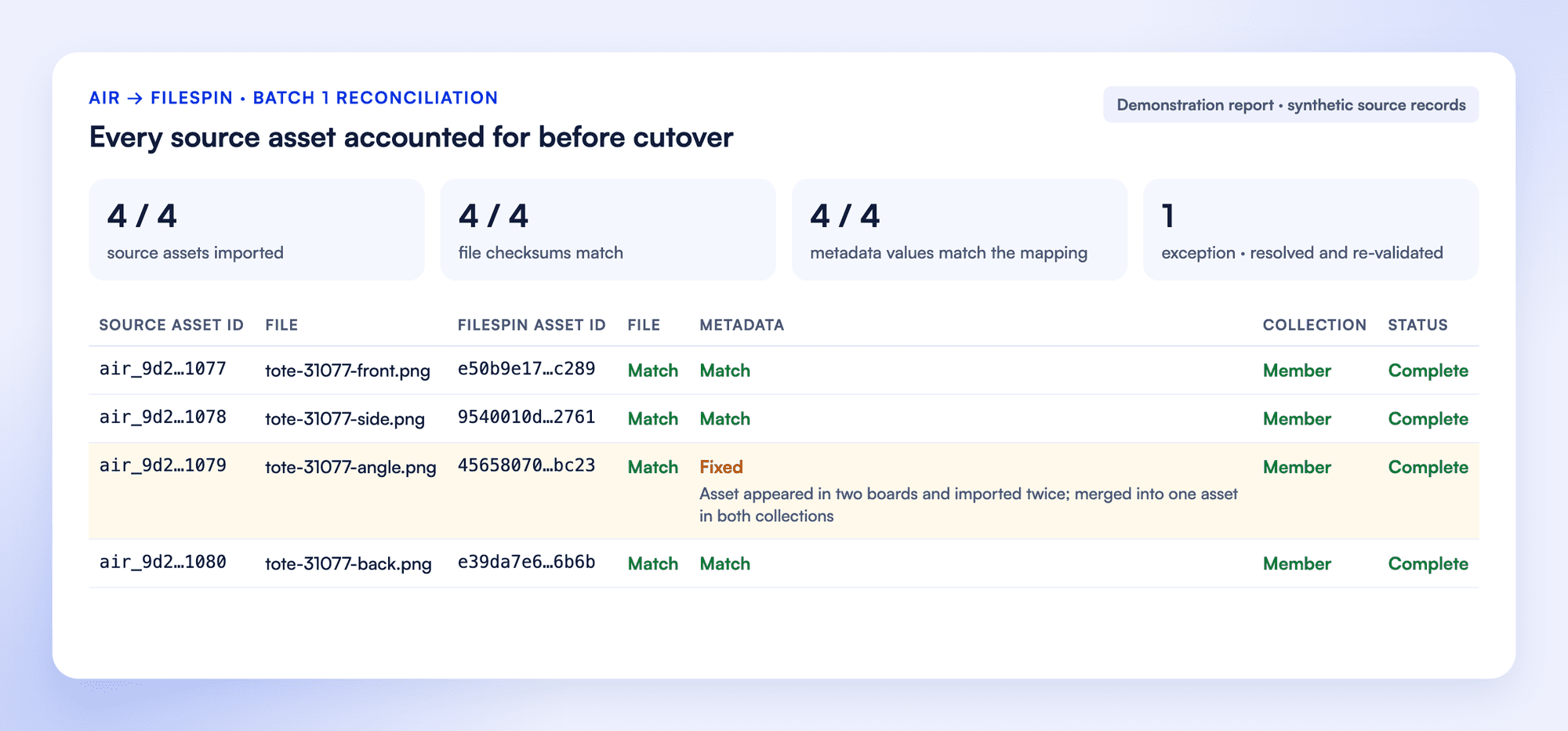
- Every exception is listed and resolved before the full run.
Air migration questions
Do our Air links keep working?
Can we keep working in Air during the migration?
Do metadata and collections come across?
Do we need to run the migration ourselves?
5. Cut over
6. Sign off the result
- Every in-scope source file has a destination ID or an accepted exception.
- Required metadata, relationships, versions and access controls pass the agreed checks.
- Applications use the intended delivery route and updates appear correctly.
- The exception report, ownership map and recovery procedure are handed over.
Plan your Air migration with FileSpin. Tell us the size of your library, the history you need and the systems it feeds, and we’ll scope an assisted or managed migration with you.